
Dependent voltage sources
The final circuit component that we are going to learn in this course are the dependent sources.
A dependent voltage source has four variants:
- A voltage controlled voltage source
- A current controlled voltage source
- A voltage controlled current source
- A current controlled current source
The four variant are depicted in Figure 1.

The four diamond shaped symbols are the dependent sources. The diamond shape differentiates them from non-dependent (circular shaped) sources. However, if you remember, the voltage sources have the lines connected through (as a short circuit) and the current sources have them draw as a interrupted line (open circuit).
With dependent sources it is exactly the same. The top two symbols in Figure 1 are those for the dependent voltage sources, the bottom two are for the dependent current sources.
Another thing to pay attention to is the value of the sources. This can be a current in the circuit to create a current controlled source, or a voltage for a voltage controlled source.
The current and voltage must always be stated somewhere in the circuit. In Figure 1 the voltage and current are defined at the resistor $$R_1$$.
In circuit analysis
To check what happens when we encounter a controlled source in a circuit we will start with the analysis of a fairly easy circuit.
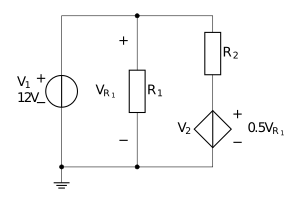
In Figure 2 we have a circuit with a dependent voltage source, where the voltage of $$V_2$$ is controlled by the voltage across $$R_1$$. We would like to find out what the voltage across $$R_2$$ is.
This example can be solved with Ohm’s law, as the circuit has two independent parallel branches.
For $$R_1$$ the voltage is known immediately as the resistor is in parallel with the voltage source $$V_1$$, thus $$V_{R_1} = V_1 = 12V$$.
With this we can assign the value for $$V_2$$, this is $$0.5 \cdot V_{R_1} = 6V$$.
And finally we can calculate the voltage across $$R_2$$, which is:
$$V_1 = V_{R_2} + V_2$$
$$12 = V_{R_2} + 6$$
$$V_{R_2} = 6V$$
Dependent sources with mesh current analysis

In Figure 3 a circuit is depicted where the voltage of the controlled source $$V_2$$ is depending on the voltage across an element in series with the source.
To solve such a circuit we will use either node voltage, or mesh current analysis to solve the entire circuit in one go. Here we will use mesh current, as we will only have to deal with a single mesh.
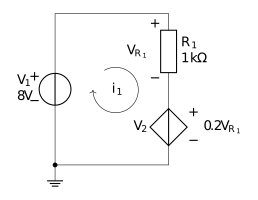
In Figure 4 we have added the mesh current and the equation can be written:
$$V_1 + V_{R_1} + 0.2 V_{R_1} = 0$$
$$1.2 V_{R_1} = 8$$
$$V_{R_1} = 6 \dfrac{2}{3}V$$
I hope you noticed that while it might look complex at first, there is not much to worry about when using these components. Just keep applying the normal steps to solve a circuit.
Now we ramp it up one notch.
Dependent sources in complex circuits

With the circuit of Figure 5 things really start to kick off. We now have two sources, one of which is controlled and two nodes, or three loops. Let’s save ourselves some work and solve this circuit using node-voltage analysis.

In Figure 6 we have named the nodes and can write down the equations. Node A can be done as we are used to:
$$-1m + \dfrac{V_A-V_B}{R_1}+\dfrac{V_A-0}{R_2} = 0$$
For the next node we start of with first putting in the dependent current source, as if it is a normal current source formula:
$$ \dfrac{V_B-V_A}{R_1} + \dfrac{V_B-0}{R_3} – 2I_{R_2} = 0$$
Because we know the dependent current source has a current with a value of $$2I_{R_2}$$ we just write it down.
The next step is to check if we can come up with a equation for I_{R_2}. Luckly we can do this, but we have to pay attention to the direction of the current.
For $$I_{R_2}$$ we get: $$I_{R_2} = \dfrac{V_A-0}{R_2}$$
We can substitute this last part into our original node-voltage equation:
$$ \dfrac{V_B-V_A}{R_1} + \dfrac{V_B-0}{R_3} – 2\dfrac{V_A-0}{R_2} = 0$$
Now we can combine everything and put it into a matrix:
\begin{gather}
\begin{bmatrix}
\dfrac{1}{R_1} + \dfrac{1}{R_2} & \dfrac{-1}{R_1} \\
\dfrac{-1}{R_1} + \dfrac{-2}{R_2} & \dfrac{1}{R_1} + \dfrac{1}{R_3} \\ \end{bmatrix}
\begin{bmatrix}
V_A \\
V_B \end{bmatrix}
=
\begin{bmatrix}
1m \\
0 \\ \end{bmatrix}
\end{gather}
\begin{gather}
\begin{bmatrix}
\dfrac{5}{3k} & \dfrac{-1}{1.5k} \\
\dfrac{-8}{3k} & \dfrac{37}{33k} \\ \end{bmatrix}
\begin{bmatrix}
V_A \\
V_B \end{bmatrix}
=
\begin{bmatrix}
1m \\
0 \\ \end{bmatrix}
\end{gather}
Putting this in the solver gives us:
$$V_A = 12.33V$$
$$V_B = 29.33V$$
And that is how we can use dependent sources in more difficult circuits.
In the end this only adds one extra step in solving a circuit, so I hope you are not overwhelmed.
Dependent sources in Thévenin circuits
Ok this part will be hard. Don’t panic if you don’t get this part, as it will require some abstract thinking, which might take a while to form.