Course Content
Kirchhoff’s current law
The holy grail of network theory is right here, so lets get started into the world of electronics.
0/3
Kirchhoff’s voltage law
This is a very nice follow up to see what other work Kirchhoff did to help you solve electric networks.
0/2
Ohm’s law
Most of you will have learned this in high school. I think this is the most known formula in electronics, and we cover it here.
0/2
Node voltage analysis
This is where is real hard work start. Node voltage analysis allows us to use KCL to solve complex circuits.
0/4
Mesh current analysis
So we solved complex circuits with KCL and node voltage analysis. We can do the same with KVL only this time it is called the mesh current analysis.
0/2
Super position
Not one but two, three, four, a thousand sources in your circuit. No problem, we can solve this with superposition (although a thousand is still a lot of work).
0/2
Thévenin equivalence
Thévenin is all about simplifying circuits. We can use this to reduce parts of circuits to a single voltage source with a resistor.
0/1
Norton equivalence
No only Thévenin has an equivalence circuit, so does Norton.
0/1
Dependent sources
You can hate these, but you'll get to love these, the dependent sources. They are our vital building blocks for the most awesome electronic component, the mighty transistor! This is also the final part we will master during this course.
0/1
Network theory

Norton transformations

Beside the Thévenin circuit there is also a Norton circuit for simplifying a circuit. The Norton circuit is a current source in parallel with a resistor. In order to get to that circuit we can just simply do \(I_{norton} = dfrac{V_{TH}}{R_{TH}}\).
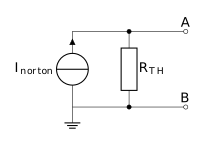
Notron circuit
Figure 1. Norton transformed circuit

This is all I’m going to say, because the two circuits are equivalent to each other, use whichever circuit you like. 
The main reason you should focus on Thévenin is because voltage sources are much more common in real circuits, so using a Thévenin equivalent circuit is preferred.