
Thévenin transformations
When designing electronics, we often do this in parts, and combine various separate sections together to form complex circuits. It is not easy to keep calculating with entire circuits as you have seen in previous examples, the set of linear equations explodes quite rapidly, when adding more components to the circuit. With Thévenin we can reduce a circuit to a voltage source and a resistor. There are some limitations which are:
- The circuit must be linear
- The circuit has only 1 port (point where we attach a different circuit)
If these requirements are met, we can simply a circuit.
The concept of load
A load is a circuit which draws power for the circuit it is connected to. This can be a complex circuit, but usually it is modeled as a single resistor like in Figure 1.

When we have the voltage across the resistor or the current through it, we can use Ohm’s law to calculate the power dissipated in the load. But this also works the other way around. If we have the Thévenin equivalent circuit, we can see what the unloaded voltage of the circuit is, so we can determine if we can connect our own circuit to it.
Equivalent circuit
The goal is to reduce a circuit to a single voltage source, with a resistor in series. This circuit looks like this:

This is it, our goal. A simple elegant and really easy to calculate circuit consisting only of a Thévenin voltage source \(V_{TH}\) and Thévenin resistor \(R_{TH}\). To get to such a circuit we have to perform two steps.
Thévenin voltage
The first step is to calculate the Thévenin voltage (\(V_{TH}\)) of a circuit. For the example we are going to use the circuit from Figure 1. The first step is to remove any load from the circuit in question. For us that means our circuit now looks like this:

Now we want to calculate the voltage \(V_{AB}\). Given \(R_1 = 4.7k \Omega\), \(R_2 = 10k \Omega\) and \(R_3 = 3.3k \Omega\) we can solve this circuit.
First up resistor \(R_2\) can be ignored, since no current flow through that resistor, so no voltage drop happens. What we are left with is a (now hopefully common) voltage divider. Our output voltage will be
\(V_{AB} = V_2 \cdot \dfrac{R_3}{R_1 + R_3}\)
\(V_{AB}= 10 \cdot \dfrac{3.3k}{8k} = 4.125V\)
This is our Thévenin voltage. That’s all there is too it, just remove the load, calculate the voltage with one of our previous methods, and we are done for this part.
Thévenin resistance
To calculate the Thévenin resistance there are two methods, one method is quick, but you cannot use it in every schematic. The other method will always work, but is more work.
Zeroing sources
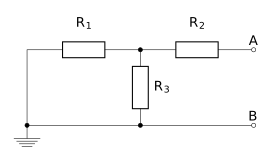
The first step for both methods is the same. We are going to zero all non-dependent sources, like we did with superposition. So voltages source become a short, current sources become an open circuit. For our circuit this means it will look like this:
Ohm’s law
Now we will use either of two methods to determine the Thévenin resistance. First we can use Ohm’s law. Just determine the resistance between \(A\) and \(B\). We can see that \(R_1\) and \(R_3\) are in parallel, follwed by \(R_2\) being in series. So the resistance from \(A\) to \(B\) is
\(R_{TH} = \dfrac{R_1 R_3}{R_1 + R_3} + R_2 \)
\(R_{TH} = \dfrac{4.7k \cdot 3.3k}{4.7k + 3.3k} + 10k = 11.94k\Omega\)
This gives us our Thévenin resistance. And now we can draw our final Thévenin circuit which looks like this:

Ohm’s law limit
We have a neat and easy way to solve the Thévenin resistance using Ohm’s law. However, can you remember the circuit from Ohm’s law exercises where we could not solve the system? I’ve drawn a variant of that circuit below in Figure 6. Due to the configuration of the system we cannot solve this with Ohm’s law. We need another method.

Impedance calculation
To properly calculate the Thévenin resistance we need to do this in with a general method, which will always work. We will calculate the impedance of a circuit, which for our case and purpose is the same as the resistance (the difference will be explained later).
Let’s solve the circuit of Figure 6 and see how we have to go about it. First we are going to null all our power supplies, so we are left with:

In Figure 7 we still cannot determine the resistance using Ohm’s law. So we have to be smart to solve this. According to Ohm’s law, resistance is the ratio between voltage and current \(R = \dfrac{U}{I}\). So instead of directly determining the resistance, we can also determine the voltage and current. Now we don’t have a voltage or current, but we can ‘create’ one.
If we add a voltage source on terminals \(A\) and \(B\), then calculate the current from that voltage source into the circuit, we can determine the resistance. So we create a circuit like Figure 8.

In the circuit we have added a new voltage source \(V_{test}\). This voltage source is here only for our calculation, so we gave it an arbitrary voltage of 1V, just because calculating with 1 is easy (most of the time). Any voltage could have been chosen.
Now we want to calculate the current delivered by the voltage source, into the circuit. This time we will use mesh-current analysis on the circuit in Figure 9.

The equations we get are:
$$R_1 i_1 + R_2 (i_1 – i_3) + R_3 (i_1-i_2) = 0$$
$$R_4 i_2 + R_3 (i_2-i_1) + R_5 (i_2 – i_3) = 0$$
$$R_2 (i_3 – i_1) + R_5 (i_3 – i_2) + 1 = 0$$
And again in separated and put into a matrix:
\begin{gather} \begin{bmatrix} R_1 + R_2 + R_3 & -R_3 & -R_2 \\ -R_3 & R_3 + R_4 + R_5 & -R_5 \\ -R_2 & -R_5 & R_2 + R_5\\ \end{bmatrix} \begin{bmatrix} i_1 \\ i_2 \\ i_3 \end{bmatrix} = \begin{bmatrix} 0\\ 0 \\ -1 \\ \end{bmatrix} \end{gather}
Solving this gives us \(i_1 = -167µA\), \(i_2 = -214µA\) and \(i_3 = -368µA\).
We are only really interested in \(i_3\) as \(I_{test} = -i_3\) so \(I_{test} = 368µA\).
Now we can compute our Thévenin resistance by diving our test voltage, by our test current:
\(R_{TH} = \dfrac{V_{test}}{I_{test}} = \dfrac{1}{368µ}= 2717Omega\)
Thévenin voltage again
If we want to complete our Thévenin circuit, we have to calculate the Thévenin voltage. To do that we are going to use node voltage analysis. First steps are choosing a reference and naming our nodes so we get Figure 10.

Now we generate our KCL equations:
$$-30m + \dfrac{V_A-V_C}{R_1} + \dfrac{V_A-V_D}{R_2} = 0$$
$$\dfrac{V_C-V_A}{R_1} + \dfrac{V_C-V_D}{R_3} + \dfrac{V_C-0}{R_4} = 0$$
$$\dfrac{V_D-V_A}{R_2} + \dfrac{V_D-V_C}{R_3} + \dfrac{V_D-0}{R_5} = 0$$
Putting it all in a matrix gives us:
\begin{gather}
\begin{bmatrix}
\dfrac{1}{R_1} + \dfrac{1}{R_2} & \dfrac{-1}{R_1} & \dfrac{-1}{R_2} \\
\dfrac{-1}{R_1} & \dfrac{1}{R_1} + \dfrac{1}{R_3} + \dfrac{1}{R_4} & \dfrac{-1}{R_3} \\
\dfrac{-1}{R_2} & \dfrac{-1}{R_3} & \dfrac{1}{R_2} + \dfrac{1}{R_3} + \dfrac{1}{R_5} \\
\end{bmatrix}
\begin{bmatrix} V_A \\ V_C \\V_D \\ \end{bmatrix}
=
\begin{bmatrix}
30m \\
0 \\
0 \\
\end{bmatrix}
\end{gather}
Using the values supplied and solving the system gives us \(V_A = 81.6V=V_{TH}\). So we have our Thévenin voltage and we can finally draw our Thévenin circuit again.

After this entire ordeal you might finally understand why we use Thévenin. If we add some other circuit to the output of our original circuit, the circuit will change each time. Instead of having to calculate everything over and over again, for various load you want to connect to the circuit, you can do this with a simple voltage source and a resistor. It is a bit of work at the start, but will save loads of time later on.
Recap
In order to calculate a Thévenin equivalent circuit we must:
- Calculate the voltage on our output terminal, without any load applied
- Null all voltage and current sources
- Calculate the resistance of the remaining circuit either by:
- Ohm’s law (if possible)
- Impedance calculation
- Add voltage source to output terminal
- Calculate the current flowing into the circuit
- Divide the voltage source by the current to get the resistance
- Finally draw the Thévenin circuit
//question, can we attach circuit x with voltage rating 4.5-5.5V and a power requirement of 10mW to this circuit?