
Kirchhoff’s Voltage Law
Mr Kirchhoff did more work besides his current law. He also devised a voltage law, besides his current law (he might have had a little too much time on hands). This law is called Kirchhoff’s Voltage Law (KVL) and it states:
If you go around any closed loop in a circuit, all the voltages you encounter sum up to zero.
Or mathematically:
\(V_0 + V_1 + \ldots + V_n = 0 \)
Looks a lot like our KCL equation doesn’t it?
Now this might sound a bit confusing, the voltages in a loop. So lets look at an example.
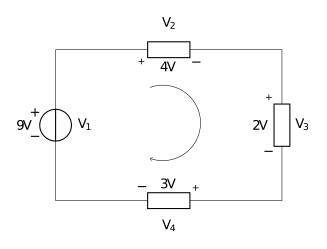

As can be seen we have four voltages \(V_1 \), \(V_2 \), \(V_3 \), and \(V_4 \).
If we were to add all the voltages in a loop together we should get 0 volts according to Kirchhoff. Lets go around the loop clockwise and see if it is true.
- We start at \(V_1 \) and we enter the component at the ‘-‘ terminal, because if we follow the arrow around the circuit (clockwise), we will first encounter the ‘-‘ terminal. So our formula becomes: \(-V_1 = 0 \).
- Next up is \(V_2 \), which we enter through the ‘+’ terminal. We add this to the equation: \(-V_1 + V_2 = 0 \).
- Following the loop we encounter \(V_3 \), giving us: \(-V_1 + V_2 + V_3 = 0 \).
- And last but not least, we find \(V_4 \), which is also added to our equation to get: \(-V_1 + V_2 + V_3 + V_4 = 0 \).
Now if we fill in all the numbers we get: \(-9 + 4 + 2 + 3 = 0 \) \(-9 + 9 = 0 \)
This seems to be valid. Now you might be wondering if I just picked these numbers to they would add up nicely, and yes I did, but in a real circuit this is also true, quite neat!
Example with 2 loops
KVL also works in a more complicated circuit.

In the circuit above we have two loops. \(V_2\) and \(V_5 \) are unknown. For the rest of the voltages we take: \(V_1 = 10V \), \(V_3 = 2V \), \(V_4 = 1V \), \(V_6 = 1V \) and \(V_7 = 5V \).
We have two loops in this circuit and lets see if we can solve them.
Going around Loop 1 gives us:
\(-V_1 + V_2 + V_7 + V_6 = 0 \)
\(-10 + V_2 + 5 + 1 = 0 \)
\(-4 + V_2 = 0 \)
\(V_2 = 4V \)
Solving Loop 2 gives us:
\(-V_7 + V_3 + V_4 + V_5 = 0 \)
\(-5 + 2 + 1 + V_5 = 0 \)
\(-2 + V_5 = 0 \)
\(V_5 = 2V \)
Now we can check if KVL is really valid. Because it states any loop should be valid. So lets check this by taking the outer loop consisting of : \(V_1 \), \(V_2 \), \(V_3 \), \(V_4 \), \(V_5 \) and \(V_6 \).
If we add them all up we should get:
\(-V_1 + V_2 + V_3 + V_4 + V_5 + V_6 = 0 \)
\(-10 + 4 + 2 + 1 + 2 + 1 = 0 \)
\(-10 + 10 = 0 \)
It is always so satisfying when it all matches up.
The flaw of KVL
There is one downside of KVL. KVL can only be used if a schematic is planar. That is a fancy word of saying it can be draw without any crossing lines. Fortunately, most circuits are planar. More complex circuits can be non-planar. See the example below:
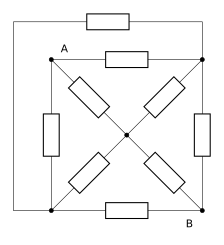
If we try to place a resistor from point A to point B we cannot do this without crossing a line. In this case KVL will not be valid, as we have to cross at least one line. In all other cases it is. It is not perfect, but very useful as we will see later on. And that all you need to know about KVL at this moment, so off to the exercises.