
Ohm’s law
Ohm’s law is used a lot, and I really mean a lot! Fortunately it is also an easy law, which makes working with it a breeze, once you have practiced enough. The law states:
$$U=I \cdot R$$
Or the Voltage \(U\) across a circuit element is equal to the current \(I\) through the element times it’s resistance \(R\).
If we have a voltage of 10V across a resistor, and the resistor has a value of 5 ohm, the current is:
$$U=I \cdot R$$
$$I= \dfrac{U}{R}$$
$$I= \dfrac{10}{5}=2A$$
By rearranging the formula we can calculate the voltage across an element \(U = I \cdot R\), the current through an element \(I = \dfrac{U}{R}\), or the resistance off an element \(R = \dfrac{U}{I}\).
Power
Ohm’s law is not only used for the relationship between voltage, current and resistance. Also power can be calculated with Ohm’s law. Power \(P \) is equal to voltage times current or $$P=U \cdot I$$. The unit of power is watt written with capital W. We can use this to calculate the power of a circuit element. If we have a resistor, with a voltage of 100V across it, and a current of 5A going through it, we have:
$$P=U \cdot I$$
$$P=100 \cdot 5=500W$$
Which is a nice heater.
Power can also be calculated by substituting \(U\) with \(I*R\) (as Ohm’s law states \(U = I \cdot R\). We get:
$$P = U \cdot I$$
$$P = I \cdot R \cdot I$$
$$P = I^2 \cdot R$$
In the same way we can substitute \(I\) with \(\dfrac{U}{R}\) giving us:
$$P = U \cdot I$$
$$P = U \cdot \dfrac{U}{R}$$
$$ P = \dfrac{U^2}{R}$$
Resistance
When using Ohm’s law we are going to work a lot with resistors. So let me tell you something about resistor networks, which can make your life a bit easier.
When resistors are connected together in circuits, they could be in a series or parallel configuration. This is not always the case, but if they are we can use this to simplify the circuit.
By solving these tiny sub-circuits we can reduce the complexity of the circuit we want to solve and make it easier to solve it.
We are going to take a look at both types, to see how we can use it to simplify our circuits.
Series resistors
In series means that they are placed after one another.

If two resistors are in series it means they are connected together, without any branches between them. In Figure 1 resistors \(R_1\) and \(R_2\) are in series. When two resistors are in series we can add the values of both resistors together $$R_1+R_2=R_s$$.
We are left with a single new resistor $$R_s$$, which replaces $$R_1$$ and $$R_2$$.
This is valid for any string of resistors as long as they are in series, so if we have n resistors in series, we can add them all up to get the total series resistance with $$R_1+R_2+…+R_n=R_s$$.
In Figure 1 resistors \(R_1\) and \(R_2\) are in series. We are allowed to redraw this schematic with only one resistor \(R_s\), which has the value $$R_s=R_1+R_2$$.
Always check if a resistor is in series or not. If any component is branching off between two resistors the resistors are not in series, like shown in Figure 2.
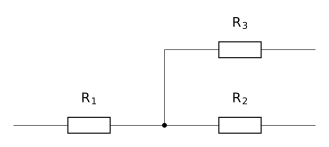
This circuit is not a series resistor, as resistor \(R_3\) creates a branch between \(R_1\) and \(R_2\).
Parallel resistance
Two resistors are in parallel when both ends of two or more components are connected together.

In Figure 3 you can see two parallel resistors. Both ends are connected to the same nodes. Parallel components are sometimes harder to spot, but again with practice this becomes more easy. When you have found two or more parallel components the resistances can be combined with the following formula: $$ \dfrac{1}{R_p}= \dfrac{1}{R_1}+\dfrac{1}{R_2}+\ldots+\dfrac{1}{R_n}$$ For two parallel resistors there is a ‘special’ equation to solve the parallel resistance (by special we of course mean someone else rearranged the previous equation for us, so we don’t have to do all the work). This is: $$R_p= \dfrac{R_1 \cdot R_2}{R_1+R_2}$$ This one is usually much faster and easier to use to people.
Let’s assume we have two resistors in parallel with \(R_1 = 100 \Omega\) and \(R_2 = 470 \Omega\)
Circuit simplification
Let’s solve a circuit with only Ohm’s law and circuit simplification. In Figure 4 we want to know the power output by the voltage source. In the current state this is too complex to calculate, so we will simplify the resistors first.

Figure 4. Circuit for simplification
Resistors $$R_4$$ and $$R_5$$ are in parallel. These parallel resistors can be combined into one equivalent resistor: $$R_p= \dfrac{R_4 \cdot R_5}{R_4+R_5} = \dfrac{820\cdot 680}{820+680} = 372\Omega $$
We can now simplify the circuit to:
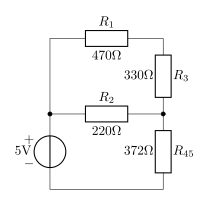
We still cannot solve the circuit, so the next step is to combine $$R_1$$ and $$R_3$$. These resistors are in series, thus we can add them together. $$R_s=R_1+R_3 = 470 + 330 = 800\Omega$$
And we are left with: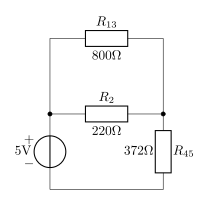
Figure 6. Two series resistors are simplified
Note that the series and the parallel simplification we just did do not have to be done in that exact order. You can also do the series resistors first, and then the parallel resistors.
However we do need to do the series simplification before we can do the next step, combining $$R_{13} $$ with $$R_2$$. Again this is a parallel resistors combination thus we can solve this with $$R_p= \dfrac{R_{13} \cdot R_2}{R_{13}+R_2} = \dfrac{800\cdot 220}{800+220} = 173\Omega $$

Now we can combine the last two resistors in this circuit, as they are in series. So we add them up and get the circuit from Figure 8.
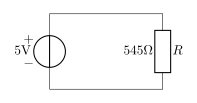
With this circuit we can finally solve our original question, what is the power output of the voltage source.
We can do this two ways. Method 1:
$$I = \dfrac{U}{R}$$
$$I = \dfrac{5}{545} = 0.00917A$$
$$P = U \cdot I = 5 * 0.00917 = 0.0459W$$
Method 2:
$$P = \dfrac{U^2}{R}$$
$$P = \dfrac{5^2}{545} = 0.0459W$$
SI prefixes
In the circuit simplification we just did we suddenly hit small currents and watts. In everyday use we come across current, voltage and power ranges in electronics which vary widely. For example resistors are often higher valued in kilo (x1000) or mega (x1000 000) ranges, but can also be just milli (0.001). To work with these values SI prefixes are used to put in front of a unit, to save some time writing down a lot of leading or trailing zeros. So from our previous example the current can also be written as $$I = 9.17mA$$, saves a lot or zeroes doesn’t it?
The table with SI prefixes that we are going to use is:
| Prefix name | symbol | factor |
|---|---|---|
| tera | T | 1012 |
| giga | G | 109 |
| mega | M | 106 |
| kilo | k | 103 |
| milli | m | 10-3 |
| micro | µ | 10-6 |
| nano | n | 10-9 |
| pico | p | 10-12 |
We will use these a lot, so some examples:
$$1k \Omega = 1000 \Omega$$ $$1mA = 0.001A$$ $$0.01V = 10mV$$ $$1000000 \Omega = 1M \Omega$$
Pay careful attention to milli (small m) and mega (capital M). The difference between them is 109 which is huge.
Voltage divider
A very common circuit in electronics is a voltage divider. The voltage divider is depicted in Figure 9.
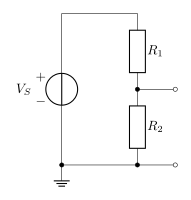
The circuit consists of two resistors and the voltage across $$R_2$$ can be determined by using Ohm’s law.
However, because this circuit is used a lot we can derrive a simpler equation to calculate the voltage across the resistor $$R_2$$.
We first start with calculating the total current in the circuit using Ohm’s law. The total current is the circuit voltage, divided by the total resistance.
$$I_S = \dfrac{V_S}{R_1 + R_2}$$
Next we can calculate the voltage across $$R_2$$.
$$V_{R_2} = I_S \cdot R_2$$
We can substitute $$I_S$$ with the formula we derrived earlier and get:
$$V_{R_2} = \dfrac{V_S}{R_1 + R_2} R_2$$
Or rewritten as our common voltage divider equation
$$V_{R_2} = V_S \dfrac{R_2}{R_1 + R_2} $$
What you can notice the that the voltage across $$R_2$$ is only determined by the ratio between $$R_1$$ and $$R_2$$ and scaled by the voltage of the source ($$V_S$$).
Remember the voltage divider, because it will return.
Current divider
Beside the voltage divider, there is also a current divider circuit.
This circuit is uncommon, but I will include it here for completeness.

The current divider circuit works similary to the voltage divider, as in it uses the ratio of $$R_1$$ and $$R_2$$ to determine the current in each resistor.
To determine the current in one of the resistors, we first need to know the circuit voltage. The circuit voltage is the current multiplied by the total circuit resistance (which in this case are two parallel resistors).
$$V_S = I_S \cdot \dfrac{R_1 \cdot R_2}{R_1+R_2}$$
When we have the circuit voltage we can calculate the current.
$$I_{R_1} = \dfrac{V_S}{R_1}$$
Substituting $$V_S$$ gives us:
$$I_{R_1} = \dfrac{I_S \cdot \dfrac{R_1 \cdot R_2}{R_1+R_2}}{R_1}$$
Now the $$R_1$$ term at the top cancels with the $$R_1$$ term at the bottom, leaving:
$$I_{R_1} = I_S \cdot \dfrac{R_2}{R_1+R_2}$$
Notice that this looks very similar to the voltage divider, except you use ‘the other resistor’ as the top term.
Don’t confuse the two.