
Kirchhoff’s current law
What better place to start the vast world of electronics at one of the most fundamental rules. It’s always nice to start off with a foundation which is always valid. Most theories or rules have exceptions or buts (nope, not the rear end of a human), but Kirchhoff’s current law does not. Beside that, it is also really simple (it doesn’t make it easy). The rule states that in any node in a circuit, the sum of all the currents is zero or:
$$I_1 + I_2 + I_3 + ldots + I_n = 0$$
Suppose we have a node (well come to what a node is in a moment) with two currents entering this node. Current \(I_1 = 1A \) and \(I_2 = 2A \) . We also have one unknown current leaving the node \(I_3 \) . We can now calculate the current by just plugging in the numbers.
$$I_1 + I_2 + I_3 = 0$$
$$I_1 + I_2 = -I_3$$
$$-I_1 – I_2 = I_3$$
$$-1 – 2 = I_3$$
$$I_3 = -3A$$
Schematics
Before we can do something useful with Kirchhoff’s law we first need to get to know some circuit symbols. In electronics we have defined a set of symbols, which we use to draw schematics. A schematic is a fancy way of describing an electrical circuit, without using a lot of words. It is based on pictures, and we like pictures. We will start with some basic elements:
| Name | Symbol | Description |
|---|---|---|
| The current source | 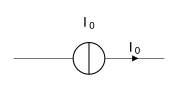 |
The arrow indicates the direction of the current flow from the source. |
| The voltage source | 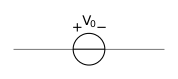 |
The ‘+’ and ‘-‘ signs indicates polarity of the source. |
| The resistor |  |
Resistors don’t have a polarity. |
| The wire |  |
And the simple elegance of the wire. |
*note, there are different symbols for the same component, you will come across them. My advice, learn them as you go along other sources and they are not wrong to use, but here we will stick to these symbols to avoid confusion and keep things coherent.
Schematics don’t just consist of some randomly put together components.
Nope, we need to connect the symbol together to get any meaning full system.
So we need to clarify how to connect stuff together.
| Connection type | Schematic view | Notes |
|---|---|---|
| Between two components |  |
If there are two components with a wire in between them they are connected. |
| Between three (or more) wires |  |
A dot indicates two wires (between multiple components) are connected. |
| A crossing (no connection) |  |
Notice that there is no dot on the point where the lines intersect. So this means no connection between the two wires. |
Kirchhoff in action
Now lets look at some examples using Kirchhoff’s current law in a circuit.
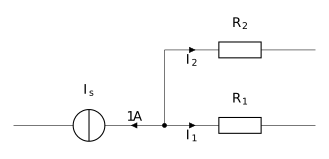
In this example circuit we see three currents. There is a current flowing through each component and they are all connected.
All components which are connected together by just wires are called a node.
Going back to the schematic, we have three currents of which one current is known.
If we are going to add up all the currents we need to define a direction. Either all currents go into, or all current go out of the node.
On this website we will use all current going out of the node, but if you choose to use all current going into a node (and do it properly) you will get the same results.
So from our node we have:
$$1 + I_1 + I_2 = 0$$
Now we can’t solve this equation because we don’t know \(I_1 \) or \(I_2 \) . Lets assume we measured \(I_1=0.3A \) , we can plug in the numbers.
$$1 + 0.3 + I_2 = 0$$
$$1.3 + I_2 = 0$$
$$I_2 = -1.3A$$
Two nodes
We are going to try to solve another example, but this time with two nodes.
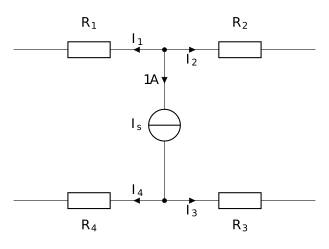
Current \(I_2 = 0.5A \) and current \(I_4 = 0.3A \) .
We can solve the top node. There are three currents leaving the node. So:
$$1 + I_1 + 0.5 = 0$$
$$1.5 + I_2 = 0$$
$$I_1 = -1.5A$$
For the bottom node it is slightly different. Because we know the current from our current source is flowing into the node, we can assign a negative value for it.
Note, only do this if you know the current. If the arrow of for example \(I_4 \) was pointed to the right, we would ignore it and assume it pointed left.
With this in mind we can plug in the numbers.
$$-1 + I_4 + 0.3 = 0$$
$$-0.7 + I_4 = 0$$
$$I_4 = 0.7$$
This all works out nicely. If we check the whole system, we see \(1.5A \) entering at \(I_1 \) (because of the negative value, the current actually flows in the opposite direction of the arrow).
Next we see \(0.5A\) leaving at \(I_2\), the rest of the current \(1A \) flows into the current source. Finally the current splits into two currents of \(0.3A \) for \(I_3 \) and \(0.7A \) for \(I_4 \) .
As you can see from the example we can solve each and every node individually. Each set of equations we define are independent. This will become a problem if we have multiple equations with multiple unknown values.
But with Kirchhoff we can still solve these systems. We will come back to those systems in a while and that is where the actual beautiful stuff will start.
For now this is all you need to know.