
Mesh current analysis
In the last lesson we have learned to solve complex circuits with KCL. We can do the same with KVL, and this method is called the mesh current analysis.
Loops
Do you still remember KVL? It states that the voltages in a loop all add up to zero or \(V_1 + V_2 + \ldots + V_n = 0\). For mesh current analysis we have to find all independent loops in a circuit. An independent loop means that the loops should not ‘overlap’. What I mean with overlap is harder to tell, but easier to show. In Figure 1 we have a very basic circuit. In this circuit we are going to place two loops for KVL which are not overlapping.
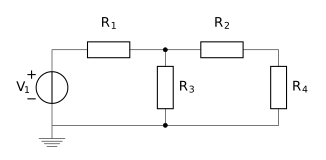
In Figure 2 two loops have been drawn. When drawing a loop in a circuit always draw them either clockwise or anti-clockwise. As long as you don’t mix the two you are fine. On this website we will use clockwise loops for consistancy, and because clockwise is shorter to type compared to anti-clockwise.

Both loops do flow through the same component \(R_3\), but they don’t ‘overlap’. As long as two loops share a component, but the currents of the loops run in opposite directions we are fine. An overlapping loop in this circuit would be a current flowing through \(I_1\), \(R_1\), \(R_2\) and \(R_4\). It would overlap with either \(i_1\) or \(i_2\). This is shown in Figure 3. The easiest way to find a complete set of independent loops is to just select the smallest loops possible enclosed by components (like in Figure 2).

KVL equation time
To solve a circuit using the mesh current analysis we are going to be copying node voltage analysis. Instead of defining nodes like we do with node voltage analysis, we are going to define loops. Each loop gets a current assigned to it (which you might have already guessed based on the naming of the loops). The next step is to define the KVL equation for that loop. KVL states all voltages in a loop add up to zero.
For loop \(i_1\) from our circuit in Figure 2 we get:
$$ R_1 i_1 + R_3 \left( i_1-i_2 \right) -V_1 = 0$$
This needs some explaining. We are working with KVL, but for our loop we have selected the current $$i_1$$.
- According to Ohm’s law we can state \(U = I \cdot R\). When we encouter a resistor, we can multiply the resistance with our loop current to get a voltage (hence \(R_1 i_1\)).
- If two currents flow through a single components we have to subtract the other current (as is it going in the opposite direction). Therefore at resistor \(R_3\) we have to subtract current \(i_2\) from our loop current \(i_1\).
- When we encounter a voltage source we just add the voltage to the loop. But watch out! there is a catch, you must add the voltage source polarity by the sign you enter it. In Figure 2 our current enters the voltage source from below (remember we are going clockwise around the loop), and the first terminal we encounter is the negative terminal. Thus this voltage source is subtracted from our total.
- And it should all add up to zero, which concludes the equation
For our second loop we get:
$$R_2 i_2 + R_4 i_2 + R_3 \left( i_2 – i_1 \right) = 0 $$
Note that this time we subtract \(i_1\) from \(i_2\), because the loop that we are calculating is \(i_2\). So always subtract the other currents from the loop you are calculating.
Matrix time
The next step is to do something familiar. We are going to separate our variables, and put them in a matrix. We are going to go about our normal steps. For the first loop we have:
$$ R_1 i_1 + R_3 \left( i_1-i_2 \right) -V_1 = 0$$
$$ i_1 \left( R_1 + R_3 \right) + i_2 \left( -R_3 \right) = V_1$$
And for the second loop we have:
$$R_2 i_2 + R_4 i_2 + R_3 \left( i_2 – i_1 \right) = 0 $$
$$i_1 \left( -R_3 \right) + i_2 \left( R_2 + R_3 + R_4 \right) = 0$$
And putting it in a matrix:
\begin{gather} \begin{bmatrix} R_1 + R_3 & -R_3 \\ -R_3 & R_2 + R_3 + R_4 \\ \end{bmatrix} \begin{bmatrix} i_1 \\ i_2 \end{bmatrix} = \begin{bmatrix} V_1 \\ 0 \\ \end{bmatrix} \end{gather}
I hope you practiced the previous exercises so this step is very familiar.
Solution time
For completeness we are going to solve this circuit (by the way, for those who are wondering, yes with Ohm’s law you can already solve this circuit). Before we can solve the circuit, we need some values for the components:
\(V_1 = 8V\)
\(R_1 = 1k\Omega\)
\(R_2 = 5.1k\Omega\)
\(R_3 = 3.3k\Omega\)
\(R_4 = 1.8k\Omega\)
Plugging in the values gives us:
\begin{gather} \begin{bmatrix} 1k + 3.3k & -3.3k \\ -3.3k & 5.1k + 3.3k + 1.8k \\ \end{bmatrix} \begin{bmatrix} i_1 \\ i_2 \end{bmatrix} = \begin{bmatrix} 8 \\ 0 \\ \end{bmatrix} \end{gather}
\begin{gather} \begin{bmatrix} 4.3k & -3.3k \\ -3.3k & 10.2k \\ \end{bmatrix} \begin{bmatrix} i_1 \\ i_2 \end{bmatrix} = \begin{bmatrix} 8 \\ 0 \\ \end{bmatrix} \end{gather}
When we solve the matrix using the tool we get \(i_1 = 2.475mA\) and \(i_2 = 0.801 mA\).
With these currents we can now calculate all voltages or currents in the rest of the circuit if we would like to.
For example the current in \(R_3\) is \(i_1 – i_2 = 2.475 – 0.801 = 1.674mA\), which has a voltage across it of $$ 1.674m \cdot 3.3k = 5.524V$$.
Voltage sources
Now we know how to calculate a mesh, let’s take a look at a mesh with multiple voltage sources.
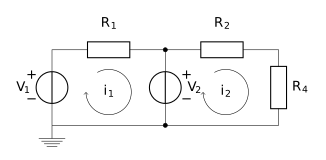
The two voltages sources in this circuit make our lives easier. We are using KVL after all, so we are trying to figure out the voltages in the loops. A voltage source already gives us the voltage, so that saves some math. The only thing we need to note is the polarity. Always add the known voltages with the correct known polarity, based on the side at which the loop enter the source.
For the circuit in Figure 3 this means:
$$-V_1 + i_1 R_1 + V_2 = 0$$ and
$$-V_2 + i_2 R_2 + i_2 R_4 = 0$$
Pay close attention to the polarities on the voltage sources. Apart from that, there is nothing special here.
Current sources
Current sources can be a great help as well. Take this nicely cooked up circuit in Figure 5.
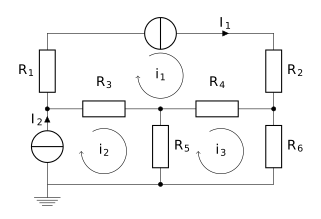
In this circuit we have two current sources. We don’t know the voltage across a current source, so this is a problem. However, the current sources are not shared between currents. If you look closely, you can see that current \(i_1\) has to be the same as the current \(I_1\) (please don’t get confused by the small \(i\) and capital \(I\)). As long as a current source is not shared by multiple current loops, we get a free solution.
In this circuit \(i_1 = I_1\) and \(i_2 = I_2\). We have the added benefit here that the currents of the source are aligned with the currents of our loops. If they are not aligned the polarity will be flipped.
When we solve this circuit all we are left with is the equation for loop \(i_3\):
$$ \left( i_3 – i_2 \right) R_5 + \left( i_3 – i_1 \right) R_4 + i_3 R_6 = 0$$
Which only has one unknown variable, so we can solve this directly.
Super mesh
Of course you already noticed the evil hiding in the previous example. If we do have a circuit with a current source, which is also shared by two mesh currents, we are in for a treat. Take this circuit:

We cannot say \(i_2 = I_1\) because we have to subtract \(i_3\) from it.
But for the mesh current analysis to work, we need to know the voltage across all components in a loop, which is not possible here, because the voltage across \(I_1\) is unknown.
This is a similar problem with node voltage, where we don’t know the current through a voltage source.
We can circumvent this by creating a super mesh. Remember from KVL that any loop in a circuit should add up to zero. We we can expand our loop to just not include the current source.

This super mesh that we created must combine the loops which share the current source. Now we can write down our normal equations again:
First for $$i_1$$
$$i_1 R_1 + i_1 R_2 + \left( i_1 – i_3 \right) R_4 + \left( i_1 – i_2 \right) R_3 = 0$$
And for our super mesh we get:
$$ i_2 R_5 + \left( i_2- i_1 \right) R_3 + \left( i_3 – i_1 \right) R_4 + i_3 R_6 = 0$$
For all equations we use the names of the loops as we have drawn them in the circuit originally.
Like with node voltage, we only have two equations, with three unknowns.
We need to have a third to be able to solve the system.
The last equation comes from the very start of this section, $$i_2 – i_3 = I_1$$.
As these current both share the current source.
Now we have a full set and we can solve this circuit.
Side note
Since this analysis is based on KVL, we have to check if the circuit is planar before we can apply it. Remember that KVL only works on planar (no crossing lines) circuits. Don’t forget this.
Summary
To solve a circuit using mesh current analysis the following steps are taken:
- Place loop/mesh currents in the circuit (all clockwise), making sure there is no overlap (don’t cross wires to be sure).
- Name the currents
- Check the loops to see if two currents share a current source
– If there is a shared current source, create a supermesh - Write down the KVL equations for each mesh
- Combined the equations into a matrix
- Solve the circuit